

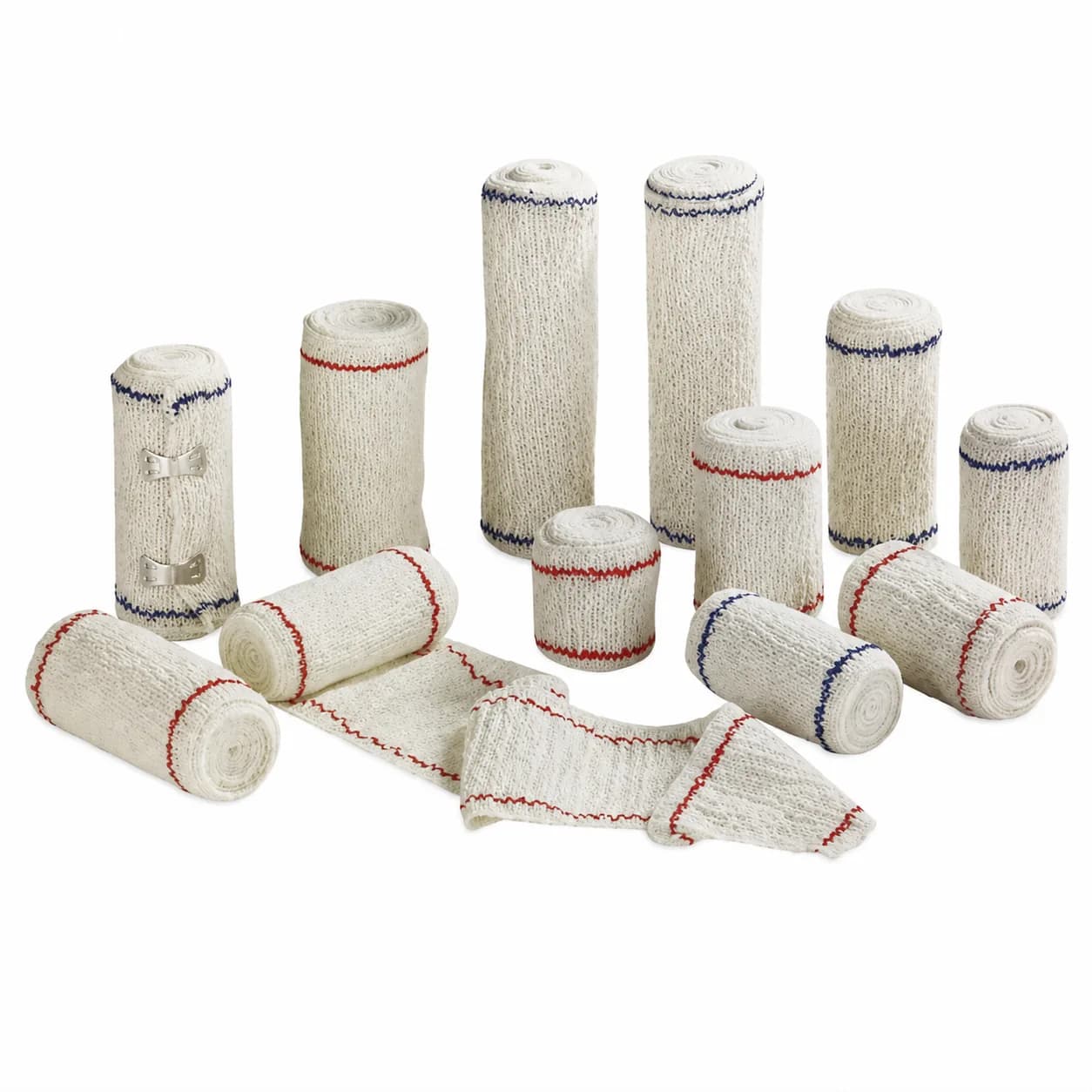
Two quotations for "7.5 cm crepe bandage, 4.5 m" can differ by a third and both be honest. The usual reason is not the cotton content and not the weave — it is that one supplier is quoting the relaxed length and the other the stretched length, and neither puts the word on the offer sheet. On a container of mixed widths that single undeclared basis is the largest line item nobody audits, and it reappears at goods-in as a short-delivery claim that the supplier will win. So the first question on this category is not which bandage. It is: which length basis, and is it printed on the pack. Ask it of every supplier, including us.
The three products, and what each is actually for
The names overlap because three different trades named them. Commonwealth and Indian buyers say crepe bandage; American buyers say elastic bandage or wrap; cohesive is the one that sticks to itself.
| Crepe bandage | High elastic bandage | Cohesive bandage | |
|---|---|---|---|
| Construction | Cotton-rich crinkled weave — ours is 80% cotton with 20% spandex | Spandex-based, higher extensibility, supplied with clips | Coated so it grips itself, not skin; needs no clip or tape |
| Typical duty | Holding dressings in place; light to moderate support | Firmer support where the limb will move | Where a clip would be lost or picked off, and over hair-bearing skin |
| Widths we carry | 5, 7.5, 10, 15 cm | 5–15 cm | 2.5, 5, 7.5, 10, 15 cm |
| Length | 4.5 m — ask for the basis per item with the quotation | 4.5 m, same | 4.5 m, same |
| Closure | Tuck or tape | Clips supplied | None needed |
| Latex position | Confirm per item | Confirm per item | Available both with natural rubber latex and not made with natural rubber latex — this is a specification choice, not a grade |
The thing to carry out of that table: none of these is a therapeutic compression system. Sustained compression for venous disease is a prescribed multi-component system with a pressure target, and a crepe bandage is not a cheap substitute for it. Suppliers who blur that line win one tender and lose the account.
BS 7505 is how you make the comparison objective — and it changed in 2025
There is a test standard for exactly this. BS 7505, Elastic properties of flat, non-adhesive, extensible fabric bandages, covers woven and knitted flat non-adhesive extensible bandages and classifies them by function and performance. Using its method, bandages fall into three groups:
| Type | What it is | What you are buying it to do |
|---|---|---|
| Type 1 | Conforming / retention | Hold a dressing. Extensibility is incidental |
| Type 2 | Light support | Support a joint that will still be used |
| Type 3 | Varying degrees of compression | Apply pressure, as part of a system |
Two things make this commercially useful. First, it converts "firm support" from an adjective into a test result you can put in a purchase order. Second — and this is the current trap — BS 7505:2025 was published on 30 May 2025 and supersedes the 1995 edition. A test report quoting the 1995 edition is not automatically wrong, but it tells you when the file was last touched, and some catalogue pages still describe the old edition as current. Ask for the report and the edition, in the same sentence.
A caution against over-claiming, because buyers get burned the other way too: the classification of compression bandages is genuinely contested in the clinical literature, which documents a lack of agreement on classification and confusion over the terms elastic, inelastic and stiffness. So treat "short stretch" and "long stretch" as trade shorthand, not standard terms, and pin specifications to the test method rather than to the adjective.
Where two quotations differ
In rough order of money:
- Length basis — relaxed or stretched, declared or not. First, and usually the whole price gap.
- Width tolerance and edge finish. A 7.5 cm bandage running 7.1 cm is a real cost saving for the seller.
- Cotton content and yarn count on the woven line; spandex content and recovery on the elastic line.
- Classification evidence. A BS 7505 report per item against a type-test certificate recycled from a sibling product.
- Latex position on the cohesive line. Two different compounds, two different prices, two different label sets.
- Pack presentation. Individually wrapped, polybag or bulk, and whose print runs on the wrap.
RFQ fields, ordered by how much they move the number
- Destination market — it sets the labelling language, the document pack and whether a medical-device route applies at all.
- Per line: product type, width, length with the basis stated in words, and the BS 7505 type you are buying to.
- Composition with tolerance — cotton and spandex percentages, and the recovery you expect after extension.
- Latex or not made with natural rubber latex, per item, with the declaration wording you need on the pack.
- Presentation: individually wrapped, polybag, or bulk; count per inner and per carton.
- Print: pack artwork, language versions, barcode ownership, who signs off.
- Sterile or non-sterile. If sterile, the route and whether the quoted lead time includes release.
- Inspection stage, who pays, and the annual volume behind the first order.
Inspection and the AQL question
Sampling is the uncontroversial half: pull against ISO 2859-1, general inspection level II, with the lot defined as the production batch.
The acceptance figure is where buyers drift, and the drift comes from a glove standard. Bandages carry no statutory acceptance number; the category where one is written into law is examination gloves, where the US applies AQL 2.5 under 21 CFR 800.20 and the EU AQL 1.5 under EN 455-1. A supplier offering "the usual AQL 1.5" for bandages has read it off a product they are not selling you. Define the classes yourself with named examples: width or length out of tolerance against the declared basis, edge fraying, clip missing or deformed, cohesive failing to grip itself, print illegible, wrap seal open, lot code missing, carton crush. We accept the inspection company you nominate, or we use the inspection company we work with on a continuing basis.
Packing, cube and the tariff line
| Commercial term | What to fix in the purchase order |
|---|---|
| Packing hierarchy | Roll → wrap → inner → export carton → pallet, with the count at every level, carton dimensions and gross and net weight per width |
| Count reconciliation | Reconcile by roll, not by carton. Widths share a carton size at different roll counts, and that is where the credit note starts |
| Loadability | As planning figures only: 20ft roughly 26–28 m³, 40ft 55–58 m³, 40HQ 65–68 m³. Bandages cube out long before they weigh out |
| Pallet configuration | Pallet type, cartons per tier, tiers per pallet, pallet-in or loose, and whether heat-treated pallets are required at your port |
| Incoterm and port of loading | State both. An EXW number, a FOB number and a DDP number are three different prices; compare only like with like, and check your own duty line first. The port of loading is confirmed with each quotation. |
| HS line | Heading 3005 carries wadding, gauze, bandages and similar articles put up for medical retail sale, with a US line at 3005.90.50. An extensible textile band not presented for medical use can argue onto a different heading — so the presentation you buy decides the duty. Confirm against your own tariff |
| Price basis | Indicative USD per carton against current cotton and spandex input costs, with a stated validity window rather than an open-ended price. An open-ended price here usually means the length basis or the width tolerance has room in it |
Price, minimum order quantity and lead time are confirmed with each quotation, against your specification and destination market. A figure offered without your width split, length basis and market behind it is a placeholder.
Regulatory route, and who carries the liability
| Market | Route | What you hold on file |
|---|---|---|
| EU | Medical device under Regulation (EU) 2017/745. Non-sterile bandages of this kind are a Class I self-declared route against an EU Declaration of Conformity | The DoC, the class and route stated on it, the EU authorised representative, and the UDI carrier as printed on your pack |
| US | Device route with establishment registration and device listing for the site, plus the premarket position for the item. Registration and listing are not an approval — 21 CFR 807.39 says so | The registration and listing position, the premarket status for the exact item, and the US agent of record |
| UK and other markets | National route with its own marking, labelling language and local representative obligations | The local responsible person and the market label set, settled before artwork is cut |
On our own side, one thing we can state rather than promise. Our Anhui production base supplies wound dressings, medical tapes, bandages and underpads. The DoC for your market is provided with the quotation. Certificate numbers and our authorised representative's details are not printed on web pages — tell us the destination market and the pack comes with the offer.
Three fields belong on your supplier file whoever you buy from: the legal manufacturer named on the pack, the EU authorised representative or responsible person where you sell into Europe, and the US agent of record where one applies. Ask every supplier for all three in writing, with entity names and addresses as they will appear on the label. We confirm ours for your destination market with the quotation.
Change control and traceability
The third order is where this goes wrong, not the first. Ask for a written change notification policy covering a change of yarn supplier, spandex content, cohesive compound, wrap film or production site. A change of cohesive compound is the one most often treated as internal — it is not, because it can move both the grip behaviour and the latex declaration on your label.
Ask for the lot code on the wrap and the export carton so a complaint traces to one batch, and for the lot-code key with the first shipment. We notify specification changes in writing; that notification is for your records — we do not hold production for a written approval from you. If your quality system needs an approval gate, raise it at the purchase order stage so it sits in the terms. Ask also for the retention sample policy and the shelf life claimed, with the data behind the months on the pack.
When a crepe bandage is the wrong purchase
If the end use is sustained compression therapy, do not buy into this category at all — buy the prescribed system, and let your clinical customer specify it. Equally, if the duty is purely to hold a dressing on a limb that will not be loaded, a Type 3 compression bandage is money spent on extensibility nobody will use; a Type 1 retention bandage at the same width does the job at a lower cost per roll. The most common version of this expensive mistake is a single tender line reading "elastic bandage" across a whole hospital, which forces one product to serve three duties and satisfies none of them.
What to send us
Send your destination market, the product types and width split, your required length with the basis you want quoted, your latex position per item, and your annual volume.
Start from the cotton crepe bandage supplier page, and compare it against the cohesive bandage wholesale and high elastic bandage with clips lines — those three pages are the whole decision. The wider wound care and fixation products range and the full medical consumables wholesale catalogue sit one level up, since bandages are almost always awarded with dressings. For the fixation side of the same award, see our medical tape buying guide.
FAQ
Is your 4.5 m length relaxed or stretched?
Ask for the basis per item in writing with the quotation, and for it to be printed where your market requires it, because the two numbers are not comparable and this is the single most common dispute in the category. Ask every supplier the same question in writing before you compare a price per roll.
How is the minimum first order set — by width or by carton?
Ask whether the minimum applies per item, per width or per carton — each width is usually its own loom setup and its own carton. On a private-label order the practical floor is usually the print minimum on the wrap rather than the bandages. Price, minimum order quantity and lead time are confirmed with each quotation, against your specification and destination market.
Can you send samples before we commit to a tender schedule?
We supply samples free of charge. Ask for the exact types and widths you want to put in front of the clinical team rather than a generic assortment.
Which documents come with the shipment?
Ask for the invoice and packing list split by HS line, the BS 7505 report for the item with its edition stated, the declaration of conformity for your market, the latex declaration wording as printed, lot numbers and shelf life, and the inspection report where agreed.