

Syringes and needles are the highest-volume line in most medical consumables catalogues, and the one where buyers most often order on price alone. The problem is that "5 ml syringe with 21G needle" is not a specification — it is a family of products whose cost varies with barrel material, tip design, needle wall thickness, lubricant, packaging and, above all, whether the device carries a reuse-prevention or sharps-protection feature. Two quotations built on different answers to those questions are not comparable. This guide walks through the specification points in the order a purchase order should state them, and names the standards that make each point auditable.
Start With the Standard, Not the Size
Four ISO standards define almost everything worth arguing about in this category:
| Standard | Covers | Why it matters to a buyer |
|---|---|---|
| ISO 7886-1 | Sterile single-use hypodermic syringes for manual use | The baseline design and test standard for the syringe itself |
| ISO 7864 | Sterile single-use hypodermic needles | Finished-needle performance: length tolerance, bond strength, flow rate, visual inspection |
| ISO 9626 | Stainless steel needle tubing | Dimensions and mechanical properties of the tube before it becomes a needle |
| ISO 80369-7 | Small-bore connectors for intravascular and hypodermic applications | The modern basis for Luer connector geometry and performance |
ISO 7886 has further parts for power-driven syringes, auto-disable syringes for fixed-dose immunisation, and syringes with reuse-prevention features. If your tender is for an immunisation programme, the part number you cite decides which factories can even bid — so cite it deliberately rather than copying "ISO 7886" from a previous order.
Write the standard <strong>and the edition year</strong> into the purchase order, then ask for the matching test report — reports "borrowed" from a sister product or an older revision are the most common documentation problem in this category.
Syringe Volumes and Where Each One Sells
| Volume | Typical use | Buyer notes |
|---|---|---|
| 1 ml (incl. tuberculin and insulin formats) | Intradermal, TB testing, insulin dosing | Insulin syringes are graduated in units, not millilitres, and are usually needle-fixed; they are a separate SKU from tuberculin |
| 2 / 2.5 ml | Routine IM and SC injection | The highest-turnover size in most primary-care tenders |
| 5 ml | IM injection, drug reconstitution | Commonly the volume-leader SKU alongside 2 ml |
| 10 ml | Reconstitution, aspiration, flushing | Frequently bought needle-free for use with drawing-up needles |
| 20 / 50 / 60 ml | Irrigation, enteral feeding, bladder syringes | Enteral and catheter-tip designs are deliberately non-Luer — do not fold them into a Luer SKU line |
Two commercial notes. First, a needle-free syringe and a needle-attached syringe are different SKUs with different MOQs and different sterilisation validation, so ask for both lines to be quoted separately. Second, graduation scale — single-scale versus dual-scale, and the graduation increment — is a real specification that clinicians notice and that some tenders mandate.
Barrel, Plunger and the Two-Piece vs Three-Piece Question
A <strong>two-piece</strong> syringe is barrel plus plunger, with the seal formed by the plunger tip itself. A <strong>three-piece</strong> syringe adds a separate rubber gasket, which gives a smoother, more controlled glide and is preferred for viscous drugs and for slow injection. Three-piece costs more.
Where a gasket exists, ask what it is made of. Latex-free synthetic rubber is now the market expectation in Europe and North America, and "latex-free" belongs on the datasheet rather than in an email. Ask also about the lubricant: silicone oil quantity affects glide force and is a known interaction risk for certain biologics, so for anything beyond routine generic injectables, confirm the lubrication specification.
Barrel clarity and the durability of the printed scale are the workmanship points that generate end-user complaints; put both in the pre-shipment inspection brief.
Luer Slip vs Luer Lock
This is the most consequential single choice in the specification.
- Luer slip (slip tip) — the needle pushes on by friction. Faster to work with, cheaper, entirely adequate for routine injection.
- Luer lock — a threaded collar screws the needle on. It resists disconnection under pressure, which is why it is specified for high-pressure injection, viscous fluids, infusion connections and anywhere an accidental disconnection would mean a spill or an exposure.
Both are governed by the small-bore connector standard. If you supply hospital tenders, expect Luer lock to dominate; if you supply clinics and pharmacy retail, Luer slip usually carries the volume. Most distributors need both, and this is the first place to split the order.
Do not blur categories here. Enteral feeding syringes and catheter-tip syringes use deliberately incompatible connectors, precisely so that a feeding line cannot be connected to an intravenous line. Quoting them inside a Luer SKU family is a safety problem, not a paperwork one.
Needles: Gauge, Length and Wall Class
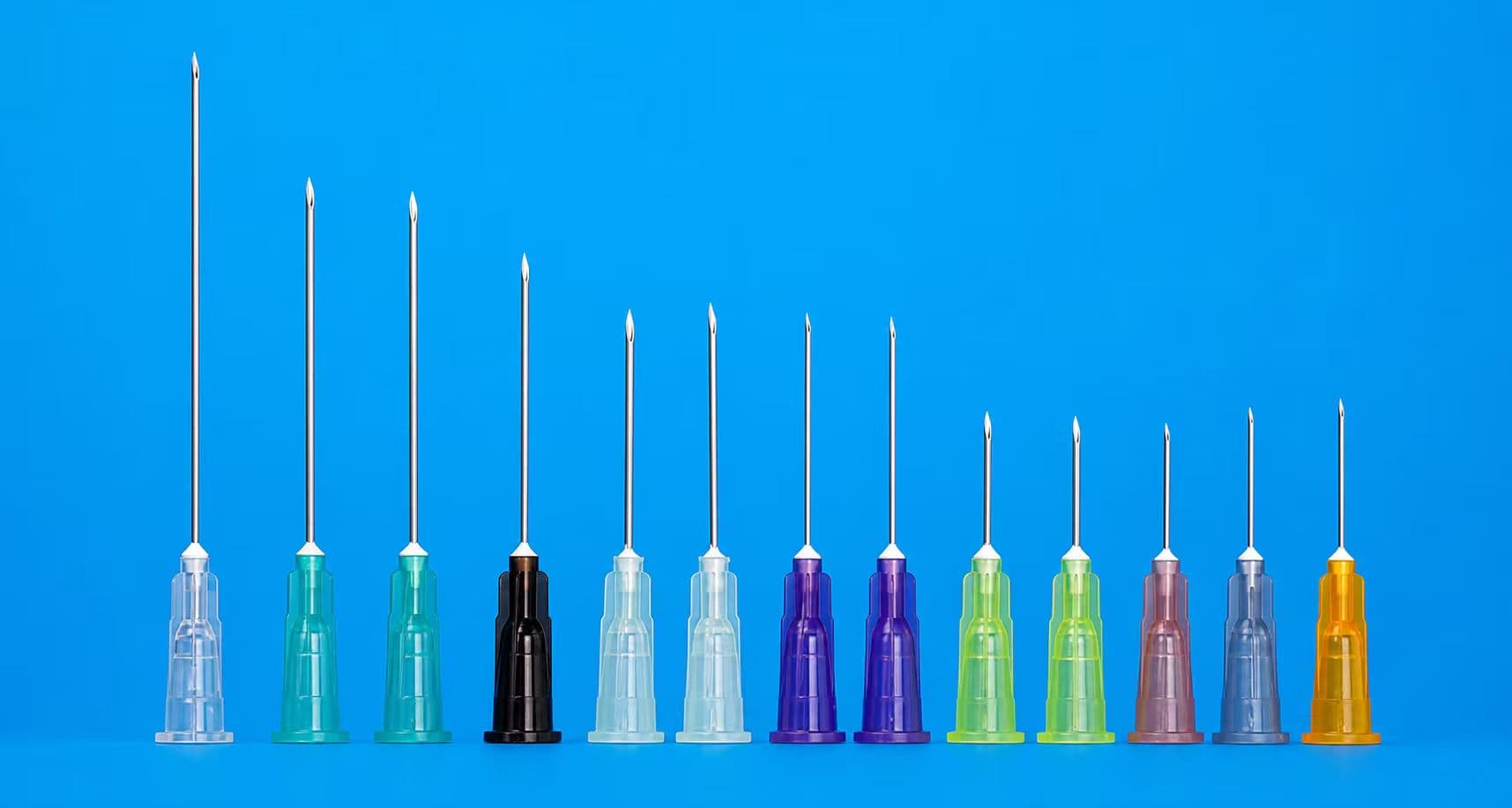
Needle gauge is a legacy designation for the tube's <strong>outside diameter only</strong> — lower gauge number means a wider needle. ISO 9626 covers rigid stainless steel needle tubing in designated metric sizes from 3.4 mm (10 gauge) down to 0.18 mm (34 gauge), and sets minimum and maximum limits for each size rather than a single figure. For 21 gauge, for example, the standard pins the outside diameter between 0.800 mm and 0.830 mm.
| Gauge | Nominal metric OD designation | Commonly used for |
|---|---|---|
| 18 G | 1.2 mm | Drawing up and reconstitution, viscous fluids |
| 20 G | 0.9 mm | Drawing up, some IM injection |
| 21 G | 0.8 mm | Routine IM injection, blood sampling |
| 23 G | 0.6 mm | IM and SC injection, paediatric use |
| 25 G | 0.5 mm | SC injection, paediatric and dental |
| 27 G | 0.4 mm | Intradermal, fine SC injection |
| 30 G | 0.3 mm | Insulin, intradermal, aesthetic use |
The gauge number is only half the specification. ISO 9626 defines <strong>wall classes</strong> — regular wall, thin wall, extra thin and ultra thin — which change the internal bore at the same outside diameter. A thin-wall 25 gauge needle has a wider lumen and therefore a higher flow rate than a regular-wall 25 gauge needle, at the same patient-facing diameter. At 25 gauge the standard's minimum internal diameter is 0.232 mm for regular wall and 0.292 mm for thin wall. If your customer cares about injection force or aspiration speed, the wall class belongs in the purchase order next to the gauge.
Length is the third dimension, and the right length for a patient population is your customer's clinical decision. Point geometry — bevel type and grind facets — separates a comfortable needle from a painful one, and is worth a sample comparison before a first order.
Finally, request the <strong>needle bond strength</strong> and <strong>flow rate</strong> test results. Both are ISO 7864 requirements, and a hub-to-cannula bond failure is the defect with the worst consequences.
Safety-Engineered and Reuse-Prevention Devices
Three different mechanisms are often confused, and they solve different problems:
| Device family | What it prevents | Typical driver |
|---|---|---|
| Auto-disable (AD) syringes | Reuse of the syringe on another patient | Immunisation programmes and public-health tenders |
| Reuse-prevention features | Refilling after the first injection | Programmes targeting unsafe injection practice |
| Sharps-protection features (retractable, shielded, hinged cap) | Needlestick injury to the healthcare worker after use | Occupational health regulation |
Sharps protection has its own standard: ISO 23908 gives requirements and test methods for evaluating sharps injury protection features — active or passive — on single-use hypodermic needles, catheter introducers and blood-sampling needles. In the European Union, Council Directive 2010/32/EU on the prevention of sharp injuries in the hospital and healthcare sector has applied across member states since 2013 and pushes employers toward devices with integrated protection mechanisms. If you are quoting EU hospital business, safety-engineered devices are not a premium upsell — they are frequently the baseline requirement.
Safety devices carry patent and tooling costs, so the price gap over a conventional syringe is substantial — and the mechanism must be genuinely single-handed in use. Always trial samples with a clinician before committing a container.
Sterilisation, Shelf Life and Packaging
Syringes and needles are supplied sterile, single-use, and typically sterilised by ethylene oxide or by irradiation. Ask which method applies to your SKU, because it determines the residual testing and the documentation set. For the packaging itself, confirm blister or peel-pouch material, the sterile barrier validation, the shelf life claimed and the stability data behind it, plus lot coding and expiry marking format for your market's language requirements. The same sterile-barrier logic that applies to dressings applies here — our guide on <a href="https://hhmeheco.com/blog/sterile-vs-non-sterile-gauze-standards-packaging">sterile versus non-sterile packaging</a> covers the packaging vocabulary in more depth.
Export cartons are a genuine cost lever in this category. Syringes are bulky relative to their value, so carton dimensions and pieces per carton drive your landed cost per unit far more than the ex-works price does. Ask for a loading plan, not just a price.
Regulatory Framing and the Document Pack
Hypodermic syringes and needles are medical devices in every significant market, and — unlike a non-sterile dressing — they are sterile, invasive devices, which places them in a higher risk class than the simplest consumables. For the European Union that means conformity under Regulation (EU) 2017/745 with notified body involvement appropriate to the classification, and an EU Declaration of Conformity available on request. For the United States it means confirming the manufacturer's FDA establishment registration and device listing, and the premarket clearance status for the specific device.
Be precise with the vocabulary in your own marketing: registration and listing are not approval, and a facility certified to ISO 13485 is a certified <strong>quality management system</strong>, not a certified product. Our <a href="https://hhmeheco.com/blog/import-documentation-medical-consumables-ce-fda-iso-checklist">import documentation checklist</a> sets out the full paperwork set to request before a first order, market by market.
FAQ
What is the difference between Luer slip and Luer lock, in one sentence?
Luer slip pushes on by friction and is cheaper and faster; Luer lock screws on and resists disconnection under pressure, which is why hospital and infusion applications specify it.
Does a lower gauge number mean a thinner needle?
No — it is the opposite. A lower gauge number means a larger outside diameter. An 18 gauge needle is much wider than a 30 gauge needle.
Two suppliers both quote "23G thin wall". Why do the prices differ?
Check the wall class is genuinely the same, then compare the tubing grade, point geometry, hub material and whether the quoted price is for a sterile needle-attached syringe or a bare needle. Wall class alone changes the tubing cost.
Do I need safety-engineered devices?
For European hospital and healthcare-employer customers, assume yes — Directive 2010/32/EU drives that market toward integrated protection mechanisms. For retail pharmacy and many other markets, conventional devices remain standard.
Can syringes and needles ship with other consumables?
Yes. They consolidate well with dressings, tapes and infusion lines in a single container — see the medical consumables range for the lines that ship together.
Planning a syringe and needle programme? Send us your volumes by size, your Luer preference, whether you need safety-engineered devices, and your destination market — we will come back with specifications, the matching test reports and a container plan. → Contact HOPE Medical
Sources consulted:
ISO 7886-1 (sterile hypodermic syringes for single use, manual use); ISO 7864 (sterile hypodermic needles for single use); ISO 9626 (stainless steel needle tubing for the manufacture of medical devices); ISO 80369-7 (small-bore connectors for intravascular or hypodermic applications); ISO 23908 (sharps injury protection — requirements and test methods); Council Directive 2010/32/EU (prevention from sharp injuries in the hospital and healthcare sector), EU-OSHA.