

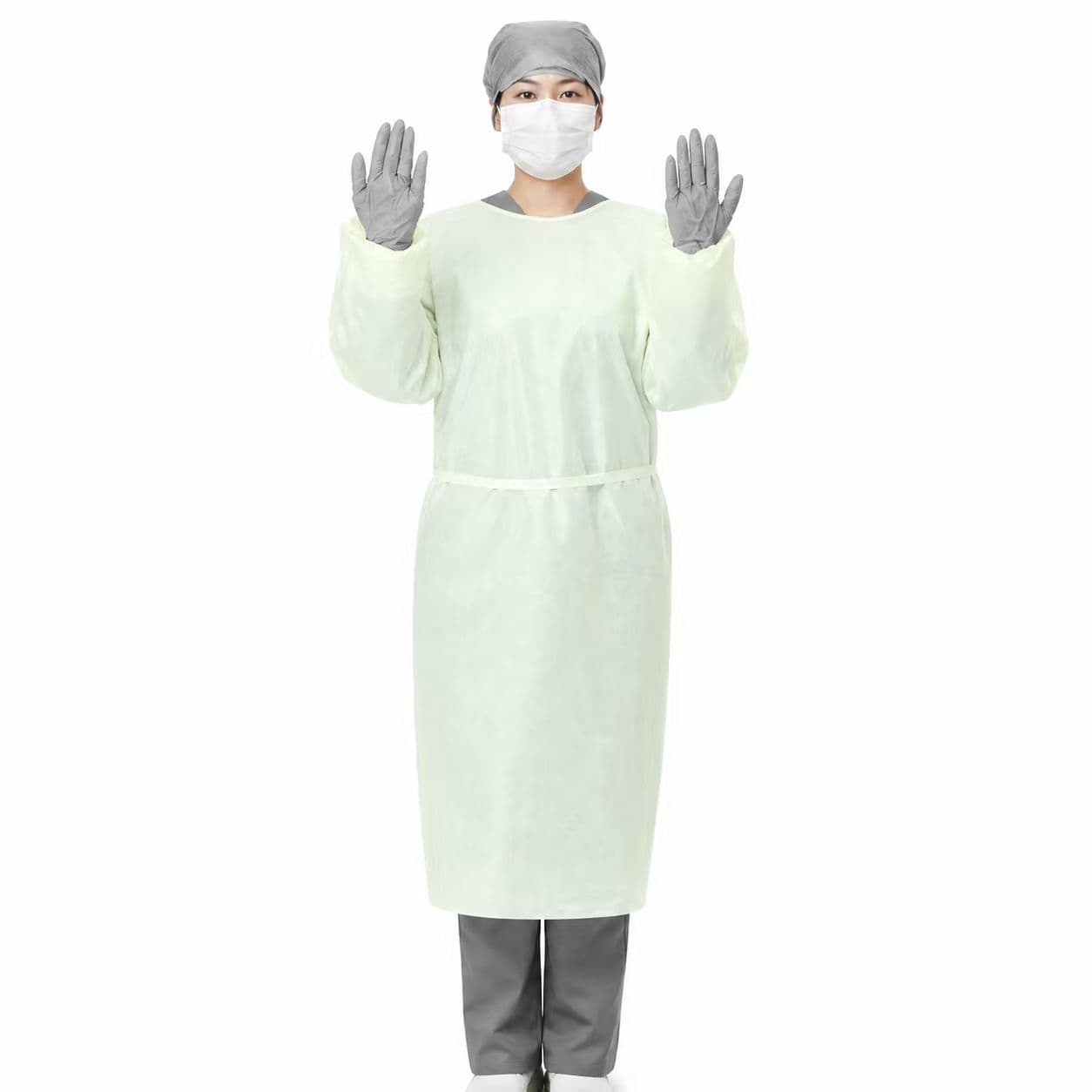
Two offers can both say "AAMI Level 3 gown" and be two different products. Under ANSI/AAMI PB70 the rating belongs to the finished garment, and the garment takes the number of the weakest critical-zone component — seams and attachment points included. So a body fabric that tests at Level 3 and a sleeve seam that does not gives you a Level 2 gown with a Level 3 price. CDC-funded testing makes the same point from the other direction: two Level 2 gowns worn together did not reliably reach single-Level-3 fluid resistance, so neither layering nor the better half of a specification gets you a level. The second gap in two otherwise identical quotations is the edition of the standard behind the report. EN 13795-1:2019 was withdrawn by national bodies in the first half of 2025 and replaced by EN 13795-1:2025, and Commission Implementing Decision (EU) 2025/2078 of 17 October 2025 amended the harmonised-standards list for surgical clothing and drapes under Regulation (EU) 2017/745. A 2019-edition report is not automatically worthless, but it is the first thing a European customer's quality team will circle — and re-testing to the current edition takes lab time you have to schedule, not argue about after the container lands.
The two rating systems, side by side
The US system classifies by liquid barrier. The European system classifies by a battery of performance characteristics split between critical and less critical areas. They are not convertible, and a supplier offering to "convert" one into the other is telling you something about their documentation.
| ANSI/AAMI PB70:2022 level | AATCC 42 impact penetration | AATCC 127 hydrostatic pressure | Blood / viral challenge | Typical commercial use |
|---|---|---|---|---|
| Level 1 | ≤ 4.5 g blotter gain | Not required | None | Visitor and basic care apparel |
| Level 2 | ≤ 1.0 g | ≥ 20 cm | None | General ward isolation |
| Level 3 | ≤ 1.0 g | ≥ 50 cm | None | Higher-fluid procedures, most tender lines |
| Level 4 | Replaced by the challenge at right | Replaced by the challenge at right | ASTM F1671, bacteriophage Phi-X174, no penetration | Surgical gowns for fluid-heavy surgery |
Two things on that table are worth more than the numbers. Levels 1 to 3 are water-only challenges, and CDC-hosted material states plainly that no correlation can be drawn between the AATCC water tests and ASTM F1671 viral penetration — so if a tender says "viral barrier", only Level 4 answers it. And PB70:2022 widened the scope beyond surgical gowns, drapes and isolation gowns to other apparel, so a 2012-edition report on a lab coat or coverall is a conversation, not a pass.
| EN 13795 characteristic (gowns) | Standard performance | High performance | Area |
|---|---|---|---|
| Resistance to liquid penetration | ≥ 20 cm H₂O | ≥ 100 cm H₂O | Critical area |
| Resistance to liquid penetration | ≥ 10 cm H₂O | ≥ 10 cm H₂O | Less critical area |
| Microbial penetration, wet (barrier index) | ≥ 2.8 | 6.0 | Critical area |
| Microbial penetration, dry (log₁₀ CFU) | ≤ 2 | ≤ 2 | Less critical area |
| Bursting strength, dry and wet | ≥ 40 kPa | ≥ 40 kPa | Critical area |
| Tensile strength | ≥ 20 N | ≥ 20 N | Both, wet in critical area |
| Linting | ≤ 4.0 log₁₀ lint count | ≤ 4.0 log₁₀ | Both |
Treat those figures as the shape of the table and make the laboratory confirm them against the edition it tested to — values and part numbering have both moved between editions. The buyer-side action: ask for the report cover page, not a summary sheet. It carries the edition year, the lab, the sample reference and the date, and those four fields are what a tender or customs challenge turns on.
Where two gown quotations actually differ
Material is rarely the gap. The spread sits in six places, in roughly this order of money:
1. <strong>Critical-zone coverage.</strong> A gown with the Level 3 fabric only on the front panel and forearms is cheaper than one with it on the full sleeve. Both can be labelled Level 3 if the tested zones pass. 2. <strong>Fabric construction at the same gsm.</strong> SMS, SMMS and PE-film-laminated SMS behave differently at 40 gsm; the laminate costs more and breathes less. 3. <strong>Sterile or non-sterile.</strong> Sterile adds packaging, process validation and release time, and in the EU it changes the regulatory route (below). 4. <strong>Closures and cuffs.</strong> Knitted cuffs, thumb loops, neck binding and tie type are each a line on the bill of materials. 5. <strong>Report scope.</strong> One report per fabric roll lot is not the same as one report per finished-goods batch. 6. <strong>Inner packaging.</strong> Ten-piece inner bags cost more than bulk-in-carton and are what a hospital distributor usually needs.
Ask for the quotation broken out along those six lines. A supplier who can produce that breakdown is quoting from a bill of materials; one who cannot is quoting from a competitor's price.
RFQ fields, ordered by how much they move the price
Copy these into the enquiry. The order matters — the first four change the number by more than the rest combined.
1. Destination market and the standard you must evidence there (PB70 level, or EN 13795 performance class). 2. Sterile or non-sterile, and if sterile, the sterilisation route you accept. 3. Critical-zone map: which panels and which part of the sleeve must meet the level. 4. Fabric type and gsm, with the tolerance you will accept on gsm. 5. Sizes and the size split across the order. 6. Cuff, closure and neck specification. 7. Inner and outer packing, plus print and language requirements on the box. 8. Report and documentation set required at shipment, by market. 9. Annual volume and call-off pattern, which is what unlocks a tier. 10. Inspection regime and who pays for it.
Inspection, sampling and the AQL question
Sampling itself is not controversial: ISO 2859-1, general inspection level II, with the lot defined as the finished-goods batch rather than the roll. Name four stages in the contract — IPC in production, DUPRO near the 20 per cent mark, PSI before the container is sealed, CLC on loading. Third-party inspection houses such as SGS, Bureau Veritas, Intertek, QIMA and TÜV, or a buyer's own inspector, are the usual choices; agree which one in the purchase order.
The trap is the acceptance number. Unlike examination gloves — where the figure is set by regulation, AQL 2.5 under 21 CFR 800.20 in the US and 1.5 under EN 455-1 in the EU — gowns have no statutory AQL. It is a contractual term, so a supplier quoting you "the usual AQL 1.5" for gowns is quoting a glove standard at you. Define it yourself: critical, major and minor defect classes with named examples (seam leak, missing tie, gsm out of tolerance, print error), and the acceptance number per class.
Ask for inspection against the defect classes written into your purchase order rather than a house standard, and for the inspection report to be shared before the container is sealed.
Packing, cube and the tariff lines
Gowns are a cube commodity, not a weight commodity: they fill a container long before they trouble the payload. As planning figures, a 20ft box takes roughly 26–28 m³ of export cartons, a 40ft roughly 55–58 m³ and a 40HQ roughly 65–68 m³ — typical ranges for this category, not a loading guarantee.
| Commercial term | What to fix in the purchase order |
|---|---|
| Packing hierarchy | Inner bag (10 pcs typical) → carton (50–100 pcs typical) → pallet; carton dimensions and gross/net weight stated per SKU |
| Pallet configuration | Pallet type, tiers per pallet, whether the price is pallet-in or loose-loaded |
| Container planning | 20ft / 40ft / 40HQ cube ranges above; cartons per container confirmed from the loading plan, not estimated |
| Incoterm and port of loading | State both. An EXW number, a FOB Ningbo number and a DDP number are three different prices; compare only like with like |
| HS lines | Nonwoven gowns and lab coats: 6210.10. Coveralls sit on a different statistical line from gowns in the US schedule, nonwoven shoe covers fall to 6307.90 and bouffant caps to 6505.90 — check the duty line for your own market |
| Price basis | Per case, in USD, against the current nonwoven resin index, with an indicative band rather than an open-ended price |
That last HS row is where a mixed PPE order quietly goes wrong. A single purchase order covering gowns, coveralls, shoe covers and caps is four tariff lines, and a packing list that lumps them as "PPE" invites the broker to apply the highest line to the whole invoice. Split them on the commercial invoice before the goods move, not after.
Regulatory status, market by market
One row per market, with the honest answer in each box. "Not in place" is a better answer than a vague one — a distributor can work around a gap they can see.
| Market | Route for this product | Status for gowns |
|---|---|---|
| EU | Non-sterile gown: Class I under Regulation (EU) 2017/745, self-declared under Annex IV with no notified body certificate. Sterile gown: Class Is, where a notified body assesses the sterility aspect under Annex IX | Confirmed with the quotation |
| US | Surgical gowns are Class II with special controls under 21 CFR 878.4040, product code FYA, and go through premarket notification. Surgical apparel other than surgical gowns and surgical masks is Class I and exempt from premarket notification | Confirmed with the quotation |
| UK | UKCA route, with the same sterile / non-sterile distinction as the EU | Confirmed with the quotation |
What we can state today: our hygiene materials, dressings, underpads and tapes are produced at the group's own plant in Anhui, which operates a quality management system certified to ISO 13485:2016 and ISO 9001:2015 and holds EU MDR Class I declarations of conformity for underpads, tapes, bandages and kinesiology tape, with SUNGO Europe B.V. (Netherlands) as EU authorised representative. The Anhui plant completed an amfori BSCI social audit by TÜV Rheinland in 2026. For gowns, the documents available for your market are confirmed with the quotation.
One buyer-side rule is hidden in the EU row. If a declaration of conformity for a <strong>sterile</strong> gown shows no notified body involvement, something is wrong with the document or the claim — the sterile route requires it, the non-sterile route does not. That single field tells you whether whoever issued the paperwork understood the product.
MOQ, samples and lead time
Stock samples and development samples are different conversations. A stock sample settles fabric feel and gsm this week; a development sample answers "can you make my spec" over a cycle that includes fabric sourcing, cutting, sewing and, if sterile, process validation.
Lead time on gowns has to be quoted as production plus release, not as production. Ethylene-oxide sterilised goods need aeration and sterility release after the cycle, which typically adds a week or two over an irradiated equivalent — so a quoted "25 days" that turns out to exclude release is a missed shipment, not a small variance.
Ask for lead time quoted including sterility release where the goods are sterile, and for the release basis to be confirmed in writing with the order acknowledgement.
Liability, after-sales and change control
Who you call when something goes wrong is a tender question, not a formality. Three fields belong in your supplier file: the legal manufacturer named on the label and the declaration of conformity, the EU authorised representative, and — for the US market — the responsible US agent on record. For the group's declared Class I lines the legal manufacturer is Anhui Xiaoshan Hope Medical Devices Co., Ltd and the EU authorised representative is SUNGO Europe B.V.; the EU declaration of conformity is issued by the legal manufacturer and available on request. For gowns, the legal manufacturer and representatives named on the documents are confirmed with the quotation.
Change control is where the third order goes wrong rather than the first. Ask for a product change notification policy in writing: how many working days before a change of fabric supplier, gsm, cutting pattern, sterilisation route or site, and whether your written agreement is required. Then ask where the lot code is printed, how it decodes, the shelf life of the sterile pack, how long retained samples are kept and what the recall entry point is.
Ask for the lot code on the carton and the inner pack so a complaint can be traced to a batch, and for the lot-code key with the first shipment.
When a Level 3 gown is the wrong purchase
If the end use is visitor traffic or basic care with no fluid exposure, a Level 3 gown is money spent on a test result nobody will read: buy Level 1 or 2 and put the budget into sizes and count. And if the tender names fluid-heavy surgery, do not cover it with a Level 3 at a better price — that gap is a standard, not a negotiation.
FAQ
How is the minimum first order set — by case or by container?
Gowns are quoted by case and the first order is usually planned at pallet level rather than container level, so an assortment across levels and sizes is normal. The exact minimum belongs in the quotation for your spec and destination.
Can you ship a stock sample before we commit to a development sample?
Ask for one where the line is already in production — it settles fabric feel and gsm before anyone pays for tooling or print.
Which documents come with the shipment?
Commercial invoice and packing list split by HS line, the test report cover page for the edition you require, the declaration of conformity where one applies, and the inspection report if one was agreed.
How is the price held, and against what?
Per case in USD, with an indicative band tied to the nonwoven resin index and a stated validity window. Open-ended prices in this category usually mean the gsm has room in it.
What to send us
Send the destination market, the barrier level or performance class you must evidence, the sterile / non-sterile split, the size split and your annual volume. You get back the six-line quotation breakdown above, carton and pallet figures per SKU for your own cube maths, and the report cover pages for the editions you need.
Start from the <a href="https://hhmeheco.com/products/non-woven-ppe">disposable isolation gowns wholesale</a> range, or go straight to the <a href="https://hhmeheco.com/products/non-woven-ppe/surgical-gown">surgical gown supplier</a> and <a href="https://hhmeheco.com/products/non-woven-ppe/isolation-gowns-1">isolation gown wholesale</a> pages. For fluid-heavy surgical use see the <a href="https://hhmeheco.com/products/non-woven-ppe/reinforced-surgical-gown">reinforced surgical gown supplier</a> page, and for full-body cover the <a href="https://hhmeheco.com/products/non-woven-ppe/disposable-coverall">disposable coverall wholesale</a> page — the one on a different tariff line from gowns. The documentation set itself is broken down in our <a href="https://hhmeheco.com/blog/import-documentation-medical-consumables-ce-fda-iso-checklist">import documentation checklist</a>.