

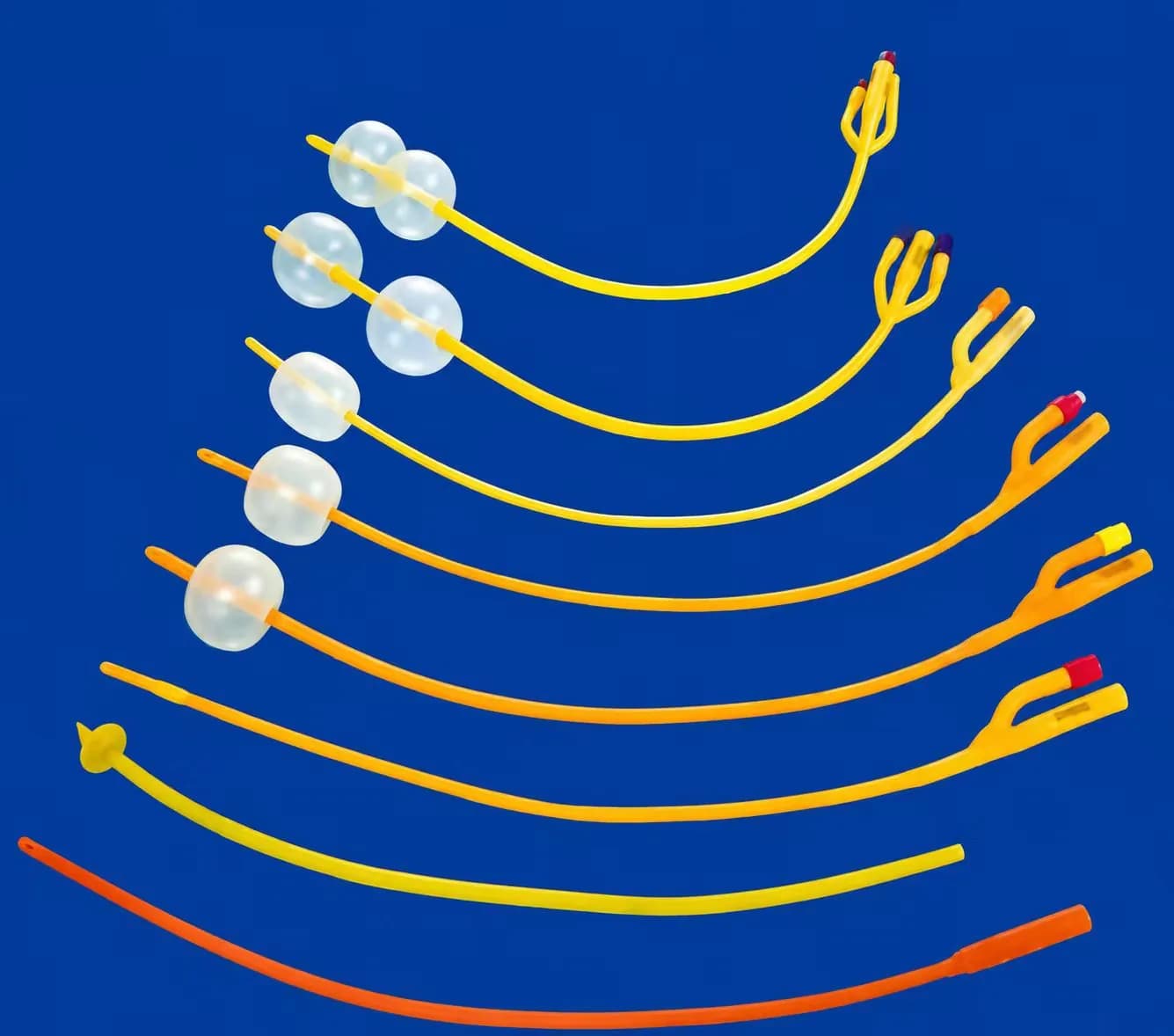
A urology tender gets re-tendered over the size mix more often than over the unit price. The schedule asks for 2,000 pieces of "16 Fr Foley, 10 ml balloon"; the wards draw down 14 Fr for routine catheterisation and 20 Fr three-way after theatre; nine months later a pallet of 16 Fr two-way sits at expiry while someone buys 20 Fr three-way at spot price. The loss is the write-off plus the emergency order, and it was decided when one line of the schedule was written.
How the French scale behaves on a bid sheet
French size is the outer circumference in millimetres, so the outer diameter is roughly the Fr number divided by three: one French unit is 0.33 mm of outer diameter. 14 Fr is about 4.7 mm, 16 Fr about 5.3 mm, and a higher number is always the larger catheter.
That matters commercially for one reason: the Fr number says nothing about the drainage lumen. A two-way and a three-way at the same 20 Fr have very different internal cross-sections, because the three-way gives up drainage lumen to the irrigation channel. Substituting across lumen counts "at the same size" to close a shortage changes the clinical product, and the ward finds out before the invoice is paid.
| French size | Approx. outer diameter | Funnel colour in common use | Where it usually lands in a hospital draw-down |
|---|---|---|---|
| 6 Fr / 8 Fr | ≈ 2.0 / 2.7 mm | Varies by range | Paediatric; long tail, usually the expiry risk |
| 10 Fr | ≈ 3.3 mm | Black in several ranges | Paediatric and small adult |
| 12 Fr | ≈ 4.0 mm | White | Routine adult, lower end of the guideline band |
| 14 Fr | ≈ 4.7 mm | Green | Routine adult; highest-volume ward line |
| 16 Fr | ≈ 5.3 mm | Orange | Routine adult; over-ordered by tender default |
| 18 Fr | ≈ 6.0 mm | Red | Drainage where clot or debris is expected |
| 20 Fr | ≈ 6.7 mm | Yellow | Three-way irrigation after theatre |
| 22 Fr / 24 Fr | ≈ 7.3 / 8.0 mm | Purple / blue | Three-way, haematuria management |
Two things to carry out of that table. First, nursing guidance pushes the other way from tender habit: the 2024 EAUN guideline recommends 12–14 Ch for routine adult urethral catheterisation, on the principle of the smallest size that drains effectively, for women and men alike. A schedule weighted to 16 Fr by habit is a step too large. Second — the part worth putting in your specification — the colour is a convention, not a requirement. ISO 20696, the standard for sterile single-use urethral catheters with or without a balloon, hands you no enforceable colour map, and ranges differ at the small sizes. Specify by the printed Fr mark and the pouch label; accept colour only as a secondary check.
Where two quotations for the same 16 Fr differ
In rough order of money, with the material grade usually third rather than first:
- Lumen count and balloon fill actually supplied against the line you wrote — the biggest spread in the category.
- Base material and coating. Silicone-coated latex and 100% silicone do not belong in one price comparison.
- Sterilisation route and what the lead time includes — where a cheap-looking quotation is funded.
- Pouch and labelling work. Each language version, process indicator and lot panel runs against its own print minimum.
- Documentation depth. A per-batch biocompatibility and EO-residuals file is not a type-test certificate recycled from an earlier lot.
- Packing level counts. Pieces per inner, inners per carton — the most common invoice dispute in consumables.
EO release is the lead-time component you cannot compress
Foley catheters in this range are ethylene-oxide sterilised, and the honest lead time for an EO product is production plus aeration plus sterility release — not the day the goods come off the line. A line-off date and a released-goods date can differ by a fortnight on identical factories, and only one of them is the date your container loads.
Ask which date is quoted, whether release documentation travels with the load, and which standards the EO file is held against: residuals in ISO 10993-7, validation and routine control in ISO 11135. A supplier who answers in writing has an EO file; one who answers "7 days, no problem" has a sales target.
The withdrawn-standard trap sits alongside it. ASTM F623, the old performance specification for Foley catheters, has been withdrawn, yet it still appears in supplier documentation and tender schedules — and when it does, it tells you the document was copied rather than maintained. Cite ISO 20696 for urethral catheters; ureteral, nephrostomy and suprapubic catheters belong to ISO 20697, a different product and a different schedule line.
The latex wording that fails a US label review
If you sell a silicone catheter into the United States, do not print "latex free". FDA's final guidance of 2 December 2014 recommends "Not made with natural rubber latex" and advises against "latex free", "does not contain latex" and equivalents, because absence of natural rubber latex allergens cannot be reliably assured and contamination can occur during manufacturing or packaging. If only one component qualifies, the statement must name it.
It is the cheapest compliance error here to fix and one of the most common to find, since the phrase sits in catalogue copy for years. On the latex line the obligation runs the other way: natural rubber latex content must be declared to the user, so confirm how that appears on pouch and carton per destination market.
What to put in the schedule, ordered by how much it moves the price
- Destination market and the regulatory route you are buying into — it sets the labelling, language set and document pack before it sets anything technical.
- Per line: base material and coating, lumen count, Fr size, balloon fill volume, catheter length (adult, female or paediatric).
- The size and lumen mix across the award, with draw-down history behind it, not a flat split.
- Sterilisation route, and whether the quoted lead time includes aeration and sterility release.
- Shelf life from date of sterilisation, and the minimum remaining shelf life you accept at delivery. Write a number; "fresh stock" is not a term.
- Pouch, label and language requirements, including the lot and expiry panel layout and barcode ownership.
- Packing hierarchy with counts at every level, carton dimensions, gross and net weight.
- Inspection stage, who pays, and the annual volume behind the first order.
Inspection and the AQL question
Sampling is the uncontroversial half: pull against ISO 2859-1, general inspection level II, with the lot defined as the sterilisation batch rather than the production run, because the sterilisation batch is what gets released or quarantined.
The acceptance number is where buyers drift, and the drift comes from a glove standard. There is no statutory acceptance figure for urinary catheters; the category where a number is written into law is examination gloves, where the US applies AQL 2.5 under 21 CFR 800.20 and the EU AQL 1.5 under EN 455-1. A supplier quoting "the industry-standard AQL 1.5" for catheters has read it across from a product they are not selling you. Define the classes instead: pouch seal breach, process indicator unchanged, lot or expiry illegible, balloon leak on test, funnel colour not matching the printed Fr mark, count short. We accept the inspection company you nominate, or we use the inspection company we work with on a continuing basis.
Packing, cube and the tariff line
| Commercial term | What to fix in the purchase order |
|---|---|
| Packing hierarchy | Piece → pouch → inner box → export carton → pallet, with the count at every level, carton dimensions and gross and net weight per Fr size |
| Count reconciliation | Reconcile by piece, not by carton: paediatric and adult lines share a carton size at different piece counts, and that is where the credit note starts |
| Loadability | As planning figures only: 20ft roughly 26–28 m³, 40ft 55–58 m³, 40HQ 65–68 m³. Catheters cube out long before they weigh out |
| Pallet configuration | Pallet type, cartons per tier, tiers per pallet, pallet-in or loose, and whether heat-treated pallets are required at your port |
| Incoterm and port of loading | State both. EXW, FOB and DDP are three different prices; compare like with like, and check your own duty line first. The port of loading is confirmed with each quotation. |
| HS line | Catheters sit under 9018.39, "other needles, catheters, cannulae and the like", with a US statistical breakout on rubber catheters. Catheters plus drainage bags is more than one invoice line — confirm each item against your own tariff |
| Price basis | Indicative USD per carton against current resin and latex costs, with a stated validity window rather than an open-ended price — an open-ended price here usually means the shelf-life position at delivery has room in it |
Price, minimum order quantity and lead time are confirmed with each quotation, against your specification and destination market. A figure offered without the Fr mix, the lumen split and the destination market behind it is a placeholder.
Regulatory route and who carries the liability
| Market | Route for a single-use urethral catheter | What the buyer has to hold on file |
|---|---|---|
| EU | Medical device under Regulation (EU) 2017/745, against an EU Declaration of Conformity; reference standards include ISO 20696, biocompatibility under ISO 10993 | The DoC, the class and route stated on it, the EU authorised representative, and the UDI carrier on your pack |
| US | Device route with establishment registration and device listing for the site, plus the premarket pathway for the product code. Registration and listing are not an approval — 21 CFR 807.39 says so | The registration and listing position for the site, the premarket status for the exact item, and the US agent of record |
| UK and other markets | National route with its own marking, labelling language and local representative obligations | The local responsible person and the market-specific labelling set, confirmed before artwork is cut |
Three fields belong in your supplier file whichever column you land in, and a hospital's risk team asks for them first: the legal manufacturer named on the pouch, the EU authorised representative or responsible person where you ship into Europe, and the US agent of record where one applies. Ask every supplier for all three in writing, with entity names and addresses as they will appear on the label. We confirm ours for your destination market with the quotation rather than printing it on a web page.
Change control, traceability and shelf life
The third order is where this category goes wrong, not the first. Ask for a written change notification policy covering a change of resin or latex compound, coating, balloon material, pouch film, sterilisation site or contract steriliser. A change of sterilisation site is the one change most often treated as internal — it is not, because it moves the validation file your hospital customer may hold.
Ask for the lot code on the pouch, the inner and the export carton so a complaint traces to one sterilisation batch, and for the lot-code key with the first shipment. We notify specification changes in writing; that notification is for your records — we do not hold production for a written approval from you. If your quality system needs an approval gate, raise it at the purchase order stage so it sits in the terms rather than in an assumption. Ask also for the retention sample policy and the shelf-life basis; a supplier who cannot say how long retention samples are held cannot support a complaint two years out, which is when a catheter complaint arrives.
When a single-source award is the wrong call
If your draw-down across Fr sizes and lumen counts is genuinely unpredictable — a mixed urology and general-ward load with no usage history — a full-year award on fixed quantities costs more in write-offs than it saves on unit price. Award the two or three highest-volume lines firm and run the tail on a call-off against a held price.
What to send us
Send your destination market, the Fr and lumen split with your draw-down behind it, balloon and length requirements, the minimum remaining shelf life you accept, and annual volume.
Start from the latex Foley catheter supplier page, or the 100% silicone Foley catheter wholesale line where your market or protocol needs a catheter not made with natural rubber latex. The broader urology and drainage products supplier range and the urine drainage bag with T-valve page are worth opening in the same session, since catheters and bags are almost always awarded together; the whole medical consumables wholesale catalogue sits one level up. For the paperwork that travels with the container, see our import documentation checklist.
FAQ
How is the minimum first order set — by Fr size, by carton or by container?
Ask whether the minimum applies per Fr size and lumen count, per carton or across the whole mix, and whether private-label pouch printing carries its own minimum. Price, minimum order quantity and lead time are confirmed with each quotation, against your specification and destination market.
Does your quoted lead time include sterility release?
Ask for the answer in writing for your order, because it decides whether a date is real. An EO product's honest lead time is production plus aeration plus release, so ask for the released-goods date, not the line-off date.
Can you send samples before we commit to a tender schedule?
Samples are supplied free of charge. Ask for the exact Fr sizes, lumen counts and balloon volumes you want in front of the wards rather than a generic kit.
Which documents come with the shipment?
Ask for the invoice and packing list split by HS line, the sterility release record per lot shipped, EO residuals results where your market requires them, the specification and biocompatibility file references, and the inspection report where agreed. Tell us the destination market and we confirm the document set for it with the quotation.